2011-07-13

There are different ways to contribute to a reading/writing community. In the Twilight fandom, there are not only many writers, but also many people who have the precious role to read and give their feedback. If we all read and write fanfiction, it's because, as readers, we were fascinated by the Twilight Saga. Some readers become writers too, or become beta-reader.

Today's guest is RandomCran. She'll tell us her experience as reader, beta-reader and writer in the Twilight fandom. Don't miss her first fanfiction:

RandomCran says:
From the moment I began reading my first fan-fiction story to the time I began volunteering as a full time beta was only six weeks. My immersion into the Fandom happened very quickly and very unexpectedly, but as the months moved on I found I really enjoyed the editing experience.

Serving as a beta has been quite valuable as it has allowed me to observe the writing styles of various authors. The process forced me to think about how I would write a story if I ever felt the inspiration to do so (although I never expected to begin writing myself.)

I was more than happy working as a beta, but one night the right idea took hold and wouldn't let go. One image of Edward kept running through my mind, and after a few days I decided to try writing it down.

Once that was done, I showed the few paragraphs I'd written to a few trusted friends. They asked to see more and so I expanded again and showed it off to them plus a few others. I kept receiving encouragement to continue on with the idea, but I still wasn't sure if I was ready to commit to writing a story.

Over a few weeks, I found the story evolving in my mind and finally decided it was time to see if my beta experience would be helpful in making the transition to author. I have to admit I have a weakness for wanting to edit my own work before sending it off to my own betas. One of them finally had to tell me not to worry about every little word or every punctuation mark – she just wanted me to focus on telling the story and asked me not to be so fixated on the technical issues.

Old habits die hard…

Since I'm only two chapters into Restless, the writing process still feels very new and raw but I feel confident about my story and have become excited about sharing it with the Fandom.


Thank you, RandomCran!

As usual, your comments are welcome. Tell us more about the way you decided to become not only a fanfiction reader, but a fanfiction writer as well!

2011-07-09

Update - the third chapter is up!
Summary: "The life of the Roman patrician Antonius is put at stake by his father, Felix. When Felix brings to his only son a new slave, Bella, more reasons arise for Antonius' concerns. Felix's secret can change Antonius' and Bella's destiny." ExB AU/vampires.


Reviewers get a little gift (different for each chapter).

Thanks to the lovely Salix caprea, there is a Twilighted thread for the story!
 
http://www.twilighted.net/forum/viewtopic.php?f=33&t=17195

^*^*^*^*^*^*^

2011-07-04

Update - the second chapter is up!
Summary: "The life of the Roman patrician Antonius is put at stake by his father, Felix. When Felix brings to his only son a new slave, Bella, more reasons arise for Antonius' concerns. Felix's secret can change Antonius' and Bella's destiny." ExB AU/vampires.

Reviewers get a little gift (different for each chapter).

Thanks to the lovely Salix caprea, there is a Twilighted thread for the story!
 
http://www.twilighted.net/forum/viewtopic.php?f=33&t=17195

^*^*^*^*^*^*^

2011-07-01

She's the incredible artist who makes extraordinary banners and blinkies for hundreds of TwiFics. Thousands of readers found new stories thanks to her works. Today's guest is Rose Arcadia!

Raum: Would you like to tell us more about the way you began to develop your blinkies and banners? What was your inspiration? Did you get a specific training on computer graphics?


Rose Arcadia: No, no, I had no training at all.  I just wanted to make a blinkie for a friend of mine, got on Google and figured out how to do just that.Inspiration?  That's the tricky part.  I know so many talented artist who can just whip these puppies up at the drop of the hat.  Me?  I'm que loca in the brain apparently.  I can love a fic, but no matter how hard I try, I can't get a visual.  Then suddenly, a chapter appears, then BAM, I've got the whole thing playing in my head.  Then I sit down and figure out how to make it on the computer.  Sometimes I don't know how to make these visuals, but hell, that does not ever stop me...
If I can't do it, I'll figure it out.  I don't care if it takes me days, I gotta get this sh*t outta my head and onto the screen!

Raum: Would you like to describe your blinkie-banner making process? How did it change during the time you have spent in this fandom? 

Rose Arcadia: Back in the day, I used to make blinkies that were 10, maybe 15 frames.  Now, I'm using about 200-250 frames.  Why?  Because somewhere along the way, we all figured out how to add videos to animated gifs.  It was a blessing and a curse.  Editing 200 frames to make them match in size, contrast, lighting and color, is not as easy as 15.
But don't get me wrong, I love adding videos to my blinkie...LOVE IT!  It gives me so many more possibilities.  I look at my Caged Bird Sings, or my Fold Your Wings blinkie....ohhh, or my Unexpected Circumstances blinkie, that one nearly killed me!  But anyways, it was just f*cking cool to see that come to life, ya know?  I did these days and days worth of work, and then I had this beautiful visual as a result.  I get a kick outta that, man!  It's an awesome feeling to see it done, I'm tellin' ya!

And the best part?  The exposure it helps the authors get.  I get so proud and giddy when they earn success from these little animations.  They deserve it.  God knows, I'm a SAHM, I can't be buying books left and right.  But these authors give me all this for free?  Hell, least I could do, if you ask me...

Raum: What tools do you use? Can you give us some specifics and technical advice on banner/blinkies making?

Rose Arcadia: I use Jasc Animation Shop 3, Picasa & GIMP to make what I need.  Especially now days, I'm a major animated banner kick, because I love combining the two.  But, I'm very anal about making the frames match in color and what not, so it probably takes me 10 times longer to do.  I'm such a geek...

Advice?  Hmmmm....play with and combine the effects, you'll learn a lot from doing that.  Oh, but just because you have the effect, doesn't mean you should use it.  The checkered effect, that would work great with a fun fic or an 80's theme fic...otherwise, not so much.  Fading is usually the way to go.

If you don't know how to transition between frames, and you want a dramatic effect, plan white or black .9 second frames can really make a powerful effect.

Font...if you have a serious fic, use a classic font.  It it's a fun fic, use a fun font.  Angst?  Find something distressed.  Period fic?  Find a font that would have been used in that century.  It makes a huge difference in selling the story.

Watch your blinkie when it's done.  Did you have time to read every line?  Too much time?  Adjust your timing to match how long it takes to read.

Also, if you fade between video frames, fade with 1 frame for .10-.12 seconds, then erase the 2 frames you faded originally.  This will make it flow continuously without stopping.

And lastly, don't forget to transition your last frame with your first frame, that way, it flows when it starts over.

I know, I know, WTF am I talking about...I'll shut up now!  Told you I was a geek...

Raum: Who is your favorite character in the saga and why?

Rose Arcadia: Edward.  Cause he's so pretty.  Like, really pretty.  Oh, and did I mention he's pretty?

Really?  I need to explain?  Ok, I just think he's beautifully flawed.  I adore that.  I adore also how, in the fandom, Edward could do no wrong.  He could kill a person and we cheer for him to redeem himself.  But go and change the name to Jacob and we demand that he rot in prison.

But yeah, mostly because he's pretty...I wish I was deep and meaningful with my answer, but apparently, I'm blinded by beauty...sue me!


Raum: Who is your favorite artist? (painter, sculptor...as you please)

Rose Arcadia: Dali, he is the creator of my love for art.  As a preteen, I once saw a replica of Three Ages above the fireplace of my Uncle's home.  I stared at it for a long, long time before my sweet Uncle came up and told me all about it.  I sat for 4 hours straight looking at it, only taking small breaks to play the french horn.
Years later, it was one of the reasons why I decided to go see a certain vampire teen movie at the theater...I was curious about the actor who was playing Dali in Little Ashes.

Raum: If Edward were an artistic masterpiece, he would be...

Rose Arcadia: Guernica?  Hmmmm, ok, maybe not, possibly in his head...oh wait, I know...Starry Night!  Hehehe!  See, this is why you shouldn't chat with your sister while doing interviews, she puts silly thoughts into you head!

Raum: Would you like to describe the relationship you established both with the authors and with the readers who, thanks to your works, find many new stories to read?

Rose Arcadia: Authors have always been so appreciative.  I love seeing or hearing their reactions.  It's better than corn on the cob at a summer picnic.  Oh, that sounds so good!

I think I'm hungry, brb...

Ok, I ate...sorry, corn craving turned into a bacon craving...yeah, long story!  So what was I saying?  Oh yes....I love how close I've gotten to authors and readers from making these.  I can't write, I would make a terrible author.  This was a great way for me to get my toe in the door and make some awesome friends.  Hell, some of my best friends now are authors who I just bonded with.  I love the sh*t outta this fandom, I'm tellin' ya...


Raum: You made many of us dream with your inspiring images. What are your dreams?

Rose Arcadia: Well, I once had a dream that Kristen Stewart climbed up my body and clawed up my face with his teeny-tiny hands.  It was all because at the time I was writing a Robp33n weekly post for The Cold Shower.  Yeah, she didn't like that.

I really, really try to keep that dream out of my artwork.  But that's ok.  I have an insane imagination and a truckload of OCD tendencies.

So yeah, I'm good to go...


Thank you, Rose Arcadia!
I couldn't make a blinkie for the queen of the blinkie-makers so...
A quote for Rose Arcadia!


2011-06-29

Today's guest for the Writing Lab is Nayarit. She's one of the extraordinary people who make A Different Forest such a good place to hang out and discuss.

Both readers and writers have a very strong opinion about the topic for today's discussion; let's read Nayarit's article about

Writing multiple POVs/redundant POVs.
---------------------------------------------------------------------
A style of fanfiction writing that has been around since the very first fanfiction is multiple first person character point of views (POV) as a primary way of storytelling. But it’s not limited to fanfiction alone. Countless authors like Marian Keyes, Charles de Lint, and even Faulkner have taken to this technique with one or many of their works. With novels such as Jodi Picoult’s My Sister’s Keeper—which used over five different first person POVs to tell the story—and Audrey Niffenegger’s The Time Traveler’s Wife—which used the two main characters’ first person POVs back and forth to tell the story—we’re seeing a growing trend of multiple first person POVs in mainstream literature.

Yet, if you were to take a poll of current Twi-fanfic readers, a growing number have expressed their annoyance and even disdain with multiple first person POVs. I took such a poll recently, and out of the fifty people that answered my survey:
- 43 (most) out of 50 readers were in favor of dual POVs, specifically Edward and Bella, but felt that more than four POVs were too much.
- 17 out of 50 readers expressed a greater affinity for stories other than multiple or dual first person POVs (such as third person, a singular first person, omniscient, etc.).
Taken into context, on a larger scale these numbers would be pretty shocking considering that a great majority of fanfictions are in fact written in dual or multiple first person.

So where are we going wrong?

The truth of the matter is writing multiple first person POV is a beast! There are many things to consider. More often than not, the task is too daunting and it’s not executed to its full potential. But when it’s right . . . it’s so right. The advantages are great, the most important being the intimacy for readers; the ability to be right there with the characters, to feel exactly what the characters feel, to understand the characters on a level that other styles can’t compare to.
What I’ve got here is my little “playbook” to writing multiple first person POVs, some things to avoid and some things to consider. It’s not a standard by any means, and as a writer you’ll find what best works for you. But here is what works for me:

Maintain character voice.

Every writer has a voice, but character voice has never been more essential to writers than when employing multiple first person. This is the most important tool to this writing style; it’s also the trickiest. When you set out to write a story, you’ve got your character in mind—likes, dislikes, emotions, history, appearance. But what you’ve got to do when it comes to first person is take that character to the next level. You’re in their mind. How does that character formulate thoughts? How does that character piece together sentences? When you write dialog for them, what do they sound like? Now take that and build on it.
This is the one true style of writing where it isn’t your voice as a writer that should shine through, it’s your characters'. So don’t be afraid to take risks. You want to show your readers that character’s voice, not just tell them. Use more contractions in text if your character calls for it. Have a character that has simple thoughts? Use simple sentences. Have a collegiate character with a high vocabulary that over-analyzes everything? Take to using a thesaurus more and writing longer sentences that are more complex. Have a character from a different country that doesn’t have the same grasp on the English language as natives? Then miss a couple of words that they wouldn’t think to use, usually your conjunctions. Use singular when plural is required or vice versa.
Each individual character has to have very individual traits: no two people are alike. Reflect that in your writing.
Once you’ve got the style that that individual character has, consider their very individual attributes that set them apart from other characters. Create a sort of list of rules per character and stick to them. Small details to your writing that make all the difference.
If one character is from Canada and another from the US then the first character would use tuque for what the second character would call a beanie. If one character likes to curse a lot, go with it. Got one that stutters? Got one that repeats a certain phrase a lot (“I mean,” “you know,” “sure, sure,” etc.)? Remember to keep specific qualities to each character to help round their individual voices out.
One final trick that I like to use to help separate my individual character voices is analogies and similes. I create very specific ones that I use for my characters, making sure they revolve around their personalities so that no other character would use them. They can be something as complex as a long set-up from their childhood that compares to what the character is currently experiencing to something as simple as one pertaining sentence.

Some examples:

A character who grew up on a farm: It was longer than waiting for the corn in July.
A character who is a sci-fi enthusiast: It was longer than the lines of a Lucas premiere.
A chocolate lover: It was like Godiva good.
A broke college student: It was like finding an extra five in my pocket during laundry day good.

From my story:

Tanya: But there was that other part of me, a part that I soon discovered wasn't dormant at all, that still wanted him more than the secret, exclusive-clientele-only, unreleased Louis Vuitton line.

Bella: I felt like John Coffey from The Green Mile, innocent in the world of sin, but charged for the crimes regardless and about to face the executioner.

Emmett: The atmosphere in here was fucking tighter than a virgin.

Just remember to maintain that unique character voice!

Watch out for redundancy.

It’s easy to get caught up in wanting to tell both sides of the story, or all sides of the story as the case may be. But when writing multiple POVs ask yourself if rehashing a scene is vital to the story. Does repeating a scene from a perspective other than the first one add something to either characterization or plot? If the answer to that question is “no,” then don’t repeat the scene. If the answer to that question is “yes,” then you want to make that answer the pivotal point in the redundant scene.
If repeating the scene is vital to characterization, bring those emotions to the forefront of the new telling. If those emotions are based on past events expose that. If those emotions were what influenced the character to behave in such a way expose that.
If repeating the scene is vital to the plot make that difference what is focused on. Showcase the stuff that the first character missed. Showcase the inside knowledge that the first character didn’t possess. Unfold additional events that help round out the scene.
Also, if recreating a scene in more than one POV is necessary, make sure to keep it fresh by minimizing or eliminating the repeat action. There is no need to redo exact phrases or dialog from the first scene if it is not completely essential to characterization or plot. Instead, offer a recap from the new character so that the scene is viewed in a new light.
Remember you don’t want to bore your reader, so always keep it fresh by making sure repeated scenes in more than one POV always bring something new to the table.

Be clear on the switch.

For some writers this is a page break. For some it’s “..xx..”. For most it’s “EPOV” or “Bella” at the top of the new POV. But the thing to remember is always make the reader aware of whose head they’re in. This trick should be used along with maintaining a specific voice so that listing whose POV it is isn’t necessary just helpful. I personally switch POVs every chapter so that with each one it’s clear to my readers they’re in a new head, and I steer away from labeling whose POV it is. But many different things work. Find the one that best suits the story you’re telling.

Sentence structure: eliminate those “I’s”

It is easy to fall into this pattern when writing in first person: “I wanted him to say no. I was disgusted that I was going to say yes. I watched him fidget and I knew he was just as anxious as me.”
Any first person POV is going to fall into the “I” trap. There isn’t anything more unpleasant to the reading eye then every sentence beginning with the same word/letter or constant repeated words/letters.
Always be mindful of falling into the “I” trap, especially when in multiple first person because it weighs a story down. Luckily for us, with a little editing and tweaking this trap can easily be controlled.
Here is just one way of fixing the above trap: “I wanted him to say no. Disgust clouded every emotion because of my answer, ‘yes’ teetering off my lips. His fidgeting clued me into just how anxious he was . . . how anxious we both were.”
You can’t avoid the “I” trap because there will be a lot of using “I” in first person, but if you’re diligent and watchful it’s not that difficult of a fix.

Keep the mystery alive.

This one is my favorite trick of writing multiple first person because one person’s point of view is very subjective. If a character were facing away, or their thoughts were on something else, there is plenty that that character can miss. And where one character falls short, the next one can pick up.
A first character is limited by what they see, hear, touch, taste, smell, and even think. Often times our own personal opinions or prejudices cloud our perceptions of events. And where better to showcase that than in multiple first person!
Using a bevy of tools—like when to cut a scene or switch POVs, limiting attention by overbearing thoughts, limiting thoughts by action that requires attention—a writer can play up the best part of keeping the mystery alive in multiple first person.

Let’s use the following as an example:

A fight is about to break out in a high school cafeteria. There are four different characters POVs to the scene. 

Character A is a cheerleader sitting at a table in the back with her boyfriend, the star quarterback. She’s picking at her nails when she hears a grunt and looks up in time to see her boyfriend’s head get slammed on the table by a male student she’s only known in passing. She quickly pushes her chair away and runs out of the cafeteria in search of help.
Character A only saw the middle of the fight and didn’t see the end. She’s the opening portion of the puzzle.

Character B is a quiet art student that sits off to the side of the cafeteria. He enjoys watching life as a means of inspiration and a slam of a door draws his attention to the front of the cafeteria where he sees a tall male student, he recognizes the student as Character C from his homeroom class. He watches with rapt interest as Character C storms through the cafeteria, heading straight for the table where Character A is sitting with her boyfriend. He watches the whole fight in its entirety, including when Character A’s boyfriend got the upper hand. Finally, he accounts how both students were rolling on the cafeteria floor before security split the two up and the principal showed up.
Character B was another portion of the puzzle. Introducing readers to Character C and allowing readers to view the entire scene.

Character C has a quick temper and loves his car. His POV starts right off in his mind as he’s waiting for the principal. He’s angry and his thoughts are jumbled because he saw red when he attacked Character A’s boyfriend. Because of this he doesn’t remember much of the fight, but he does remember a conversation he had earlier with a classmate of his, Character D, about Character A’s boyfriend slashing his tires.
Character C finally provided the reasoning behind the fight. Adding the final piece of the puzzle.

Character D is introduced as she watches security pull both student’s away. She catches the eye of Character A’s boyfriend. Her wink to him sends her into a flashback where she was walking through the parking lot to Character C’s car. As she slashes the two back tires she thinks about how it will be the perfect payback for Character A’s boyfriend, after he refused her for the last time.
Character D provided another layer to the initial scene that readers didn’t expect, enhancing the mystery of the story.

There is no need to reveal every thought or every action a character has simply because it’s first person POV. When keeping within the limits of first person a writer can mold and create a story that always keeps a reader on their toes.

I hope my little “playbook” helped provide some insight into the exciting style of multiple first person POV. If you’re willing to put in the time and effort, multiple first person can be an emotional, entertaining, and effective way to tell a story.

---------------------------------------------------------------------------

Thank you, Naya, for this outstanding playbook!

Don't forget to check Naya's stories! http://www.fanfiction.net/u/1806040/Nayarit

Readers and writers, you are very welcome to discuss! 

2011-06-27

I've just made this banner:

Fairusa asked for a banner maker on A Different Forest and we got in contact.
 
I hope you'll like her story:
Summary: "What if Victoria had gotten to Bella when she jumped off the cliff in New Moon before Jacob pulled her out of the water? Rated M for obvious reasons."
If you read this fic, don't forget to tell the author that Raum sent you and say  "Ciao" from me! Thanks!

If you need a banner or a blinkie for your story, feel free to contact me, I'll be glad to help.

2011-06-25

Many news this week!

On Wednesday night, I survived Emergency Beta Service Writing Boot Camp! 


The concept of this initiative is simple: you set a goal and EBS betas will be there to help you reach it. While you write, your assigned beta will be there to talk to you about what troubles you, answer questions, or simply encourage you.

There are three options:

Rookie. Time-driven. Sit down, start writing and try to get as much as you can in one 50 minute session.
Pro. Time-driven but with a goal (finish a scene, a chapter, an outline, etc.).
Hardcore. Time-driven while trying to reach a set word count and accomplish a set goal.

I joined a Pro camp. We set the following goals:
- discuss a scene: done!
- write 500 words; since English is not my first language, I thought that it was a very challenging goal. I ended up writing...1,010 words! I can't believe it!
- discuss a plot problem about an outline: done!

The EBS Beta, Marly580, was awesome! She helped me in every possible way! I loved her feedback and the way she encouraged me while writing.

I'm going to sign up again for a new camp as soon as possible!

I made a banner to thank EBS for this wonderful experience:


From boot to debut...this week I took an important decision too...

I've just posted the first chapter of my first multichapter story!
Summary: "The life of the Roman patrician Antonius is put at stake by his father, Felix. When Felix brings to his only son a new slave, Bella, more reasons arise for Antonius' concerns. Felix's secret can change Antonius' and Bella's destiny." ExB AU/vampires.

^*^*^*^*^*^*^
When I heard the sound of soft rain in the early morning, my body stiffened. The day wasn't starting under good auspices. I wouldn't see one of my men anymore. As if it was a day like every other one...
^*^*^*^*^*^*^

The story is already written, but now is public...

Here's the banner:


A very intense week, indeed.

Have a good weekend!

- Raum

2011-06-22

The first advice you get when you try to write a story is "show, don't tell."
You have a plot, you think that your characters have a very interesting path to go, and you're ready to follow them on it, step by step.
You already have your good reasons to write and read your story and probably your best friend will read it too - if (s)he's a very kind friend, but if you want to involve other readers, you must provide them their good reasons to spend their time reading your stuff.
Keep in mind that readers don't like to be schooled: e.g., if you say that a character is a jerk, you are telling your readers how they are supposed to feel; you are giving them your opinions. Instead, if you show your character acting in a jerkish way, your readers will decide on their own how they judge your character's behavior.

Let's see it through an example:


Here's the summary:

"Edward's the star keeper for the Forks High School soccer team, and is already being scouted by leagues overseas. Bella's just moved from Phoenix and interferes with his…focus."

It's updated at least once a day and some thousands (yep, thousands, check her reviews if you don't trust me and add your own comment) readers jump on their seats every time she posts a new chapter.

Why?

There are many reasons, of course, but I think that Offside is also a very good example of showing vs. telling.

Let's read this passage (chapter 7, EPOV)
-----------------------------------------------------------------------------------------------------

"My house was quiet and empty when I got there, so I cooked and devoured a pizza from the freezer, quickly finishing up my homework, and then pulled out my sketchbook. I had a couple hours before Dad would be home, and I was almost done with the goalie picture. Just a few changes here and there – deepening the shades, softening the angles. When I was done I pulled it out of the book and neatly trimmed the edges.

It actually looked pretty good, I thought. I narrowed my eyes at the paper, looking at it from different sides for a minute. I wondered if Ms. Denali would like it…I mean, it was
still a fucking soccer picture. Is that art? I shook my head a little before sticking it into my homework folder and placing everything into my book bag. I hauled the bag back downstairs and deposited it on the floor in the kitchen.

[...Dad arrives at home...]

"Edward! Get down here!"

Shit, what now?

I unlocked the door and headed back down the stairs.

"Yeah, Dad?" I asked as I walked into the kitchen where he was chowing down on Chinese food. My book bag was open, and my homework folder was sitting in the middle of the table.

"What the fuck is this?" he asked, shoving the sketch I had just finished over towards me.

Shit shit shit.

"Um…"

"That's not a fucking answer," he growled.

Might as well get it over with.

"I went for the art class instead of study hall," I told him. I tried to brush it off. "Another easy A for my senior year…ya know?"

"Goddamnit, Edward!" He slammed his hand down on the table, and I cringed.

"You should be out on the fucking field during that time! What the hell is wrong with you?"

"My last period is open," I told him.

"And I go to the field at lunch, I figured-"

"Bullshit," he snapped. I started to reach for the sketch, realizing too late how big a mistake that was. He grabbed it, tore it up, and crumpled the pieces in his hand. "You don't focus on this shit. Soccer, asshole. You focus on soccer, and that's it, you hear me? You think Real Volturi is going to want to look at your fucking coloring?"

"No, Dad," I admitted. He shoved the torn paper into the bag of empty soy sauce packets and fortune cookies before tossing it in the garbage can.

"Drop that fucking art class tomorrow."

My stomach tightened up into a nice little ball of pizza dough or whatever, but I swallowed hard and replied.

"Okay."

------------------------------------------------------

OK, wipe your tears.

What do we see?

1) Edward likes drawing.
Did Savage tell us that?
Nope.
But if you don't like drawing, you don't spend two hours doing it and wondering about what your art teacher will think about your work.

2) Edward's dad is a jerk.
Did Savage tell us that?
Nope.
But she showed him yelling and growling at his son, without a reason (unless you are on his side, but this would be another story...) and destroying his work.

3) Savage makes us feel Edward's passion while drawing: she doesn't say "he finished his soccer picture," but makes us see him doing it ("deepening the shades, softening the angles"). We can empathize, thinking about ourselves putting time and effort in something we love.

4) Savage makes us feel Edward's pain: "My stomach tightened up into a nice little ball of pizza dough or whatever, but I swallowed hard and replied." If we have ever experienced the same feeling, we can empathize with Edward and feel sorry for him. It seems that Edward's dad is destroying our own picture.

Let's try to tell the same scene:

"Edward spent two hours finishing a picture and enjoyed it very much. His father didn't appreciated it because he thought that Edward's focus must be on his soccer practice and destroyed the picture."
The facts are the same, but don't elicit the same reaction, right?

Even more telling and less showing: "Edward's dad is a jerk and he doesn't threat his son well."
No tears at all this time, are there?

This week's writing tip is: read Offside and underline every passage that makes you cry, laugh, hold your breath (it's a story that will make you underline many passages...)

Then write down what do the underlined passage tell (eg "Edward misses..." "Edward loves..." -- you have to read the story to find out who is Edward missing or loving LOL ) and notice the differences between telling and showing.

At this point, you may try to write your own scenes, e.g., try to write the scene above showing a caring dad who encourages Edward to pursuit his artistic career. You can share it in the comments to this post, too.

I've made a blinkie for Offside, you can see and grab it here: http://myreadinglounge.blogspot.com/2011/06/blinkie-offside-meet-soccerward.html

If you read this fic, don't forget to tell the author that Raum sent you and say  "Ciao" from me! Thanks!

2011-06-18

Would you like to read a compelling story, updated at least once a day? If so, go read:


I'm working on a review for Savage's last (great) work; in the meantime, here's a blinkie I made for it. Feel free to share it!


If you read this fanfic, please don't forget to tell the author that "Raum sent you" and say "Ciao!" from me! Thanks!

2011-06-15

Cecilia Tan

Today's guest for the Writing Lab is Cecilia Tan.
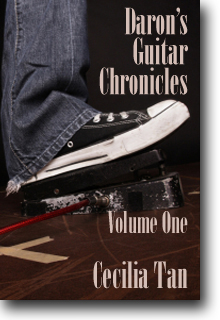
She is the author of the online serials The Prince's Boy (read online:http://www.circlet.com/?p=322) and Daron's Guitar Chronicles (http://daron.ceciliatan.com/start-here), as well as many books, including The Siren and the Sword (the Magic University series), Mind Games, White Flames, and others. You can find her on Livejournal and Twitter as "ceciliatan", on Facebook as cecilia.tan, and on her blog at http://ceciliatan.com. She also writes fanfic under the name ravenna_c_tan on Livejournal and Dreamwidth.

Many, many thanks to the lovely miaokuancha -- who wrote a lesson about Present tense vs. Past tense in fiction -- who talked to Cecilia Tan about MyReadingLounge's Writing Lab.


The Serial Form and Fanfic WIPs
by Cecilia Tan

Today I am here to write about the relationship between serialized fiction and fanfic WIPs. For those who don't know me, I'm a professional writer who started writing fanfic after I'd been publishing professionally for over a decade. I came to fanfic for fun, for the fandom community of it, for the ability to geek out and play in the world(s) that I was in love with. What I discovered, though, was that not only was fanfic tremendously fun, I could actually use it to improve my own writing. I could experiment, learn, and grow as a writer in a way I couldn't when I was only writing for commercial publication.
One of the joys I discovered was writing in the serial form. Most people assume when you are writing something "long" that you are writing a novel. But does everything have to fit into the novel form?
Modern fiction is dominated by the novel form. All the truly significant literary prizes are awarded for novels, novelists are the best compensated among fiction writers, and when most people think about being a "fiction writer" they are thinking "novelist." We typically read a lot more novels than anything else, and this shapes our expectations as readers and as writers.
However, this dominance comes more from the commercial aspects of selling fiction than from an inherent superiority of the novel over other forms (short story, serial, et cetera). Book publishers have made the novel the dominant form, but this was not always the case. In the days when newspapers and magazine periodicals ruled the roost (because books were expensive to make and own, and newspapers were people's main source of news, with major cities having dozens of daily newspapers being published!) the fiction serial was a favored form of storytelling. Many of the great stories we read today as "novels" were actually serials that were later collected. Think of Alexandre Dumas' books about the Three Musketeers and Charles Dickens.
The serial is different from the novel in much the same way that a television series is different from a movie. Everyone now accepts that a television show can tell a long, overarching story about the characters, but that each episode may only move that overarching plot forward a small bit (if at all) and that where that plot ends up may meander sometimes from where it looked like it would originally go. In television this can, unfortunately, be the product of outside forces, like actors not renewing their contracts and having to be written out of the story, for example.
But in a fiction serial, the author is in control. And at last we have a new medium that is perfect for delivery of fiction serials: the Internet. We also have another emerging form on the Internet that people have embraced: the webcomic. Some webcomics concentrate on a single story or gag each day, while others just post new pages in an ever-growing serial story.
Many writers of fanfic Works In Progress (WIPs) are trying to fit their story into the format of a novel. Your typical commercial novel is 60,000 to 80,000 words long, and has three acts. Act I, the beginning, is about the first 25% of the book. Act 2, the middle, is about 50%, and act 3, the ending, is the final 25%. In the beginning, it's all about introducing new characters, new situations, and new conflicts, and raising questions. In the middle it's all about overcoming increasing obstacles. And in the end it's all about answering all the questions that were raised and resolving the conflicts that were introduced in the beginning. Most Hollywood films follow this exact pattern as well.
But obviously the three-act structure is not the only way to tell a story. Many things that were mediocre movies made great television shows (Buffy the Vampire Slayer, anyone?) and likewise, some great shows made mediocre movies (The X Files).
A serial gives the author room to explore many issues without being on a time clock that says everything has to be resolved by chapter 20. New issues and new characters can be introduced along the way instead of all being thrown at the reader in the very beginning. In fanfic, we may already be familiar with the characters, but perhaps new plot elements or themes are being introduced and explored?
A really good WIP can be addictive. When I find a fanfic writer who is juggling a lot of balls in the air, multiple character arcs perhaps, multiple themes, and keeping them all going and going,  I just cannot WAIT for each new installment. And I've had such tremendous fun writing various fanfic WIPs myself over the years, especially from all the comments from readers who are trying to guess what is going to happen next, that I finally thought, hey, why aren't original fic writers doing this, too?
So I wrote an original fic serial called The Prince's Boy, a male/male high fantasy story with a kind of dark sex-magic theme, to see if I could recreate that same kind of excitement and if I could take my time letting the plot unfold at its own pace. It was some of the most fun I've had writing fiction, and I learned a lot.  I had the space to explore multiple characters instead of just one "viewpoint" protagonist, which created more for my readers to love, too.
And like with the fanfic WIPs I had done previously, the participation of readers in the ongoing creation of the fic is something that a novel just doesn't have.
The other thing I learned is to trust my subconscious, my muse, if you will. There is some reason why a writer gets the urge to write. It's usually because something deep inside is trying to bubble out.
Whether what you write is fanfic or original fic, that is still true. There's something inside trying to be expressed. In a serial, I had room to just let that engine run until it came full circle. Every time I had the urge to write, I indulged it, and the end result was wonderful. The Prince's Boy ran for two years, and the end result is close to 200,000 words, which is three times the length of most romance novels. It just would not have fit in a third the space. And many of the WIPs I've followed in my fandoms are the same. Some are now longer than the original source material by a factor of two (and with the Harry Potter books, that is a lot!) and are still going.
So the next time you start a WIP, remember you might really be writing something that isn't a novel. It might be a serial. It might be its own form. Where a novel is like a crown set with three jewels, a serial is like a string of pearls, where one after another after another is strung. If each chapter you write seems to be leading you to another and another and another, I would say keep following that trail of breadcrumbs until you find where it leads, even if the path meanders all over the forest in the middle. What you have in the end might be truly beautiful.


Thank you, Cecilia, for this wonderful, inspiring article!As usual, comments are welcome!
Follow me on Twitter!